400ZR and 800ZR. Engineer the whole route.
WBN designs amplified coherent networks and supplies 400ZR / 800ZR solutions, matching the host, line mode, spectrum and optical path.

WBN / Engineering resources
Engineering guides for AI fabrics, optical interfaces and coherent transport. Connect architecture decisions to the ports, fibers and operating conditions that make a network work.
Looking for a specification? Open the document library
Browse all engineering guidesFeatured technical reference / AI infrastructure
How optical shuffling connects GPU rails to multiple network planes—and what that changes about topology, deployment and cost.
Read the optical shuffle architecture guide ↗ Companion: 800G to 1.6T—lanes, optics and the fabric ↗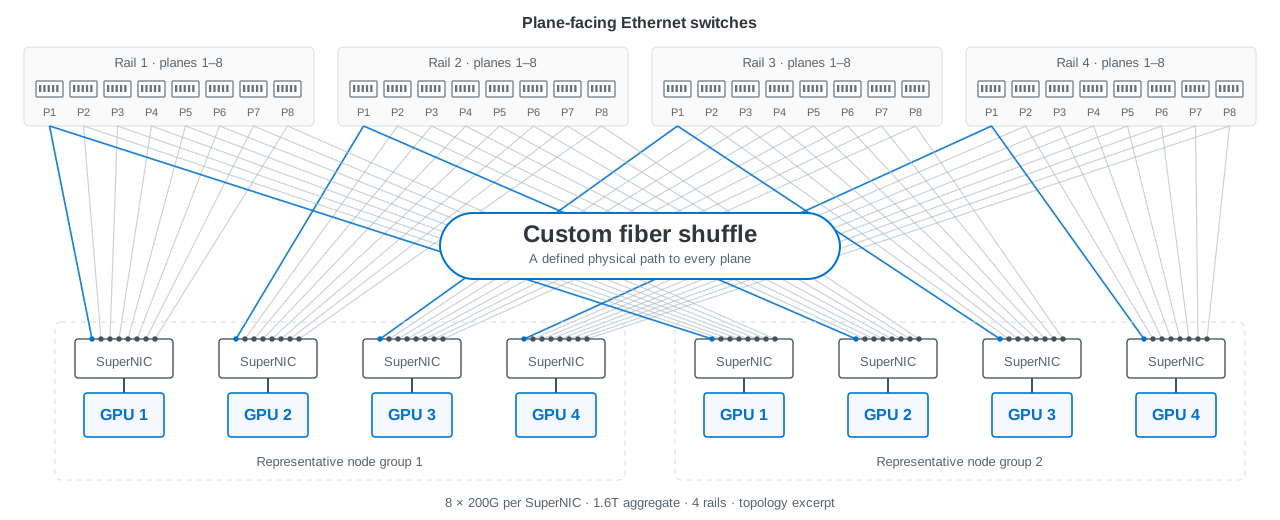 Topology · port accounting · custom assemblies
Technical library
Guides to interfaces, host requirements, fiber construction and operation.
Open document libraryWBN designs amplified coherent networks and supplies 400ZR / 800ZR solutions, matching the host, line mode, spectrum and optical path.
Understand 100G versus 200G lane architectures, 800G gearboxing, 1.6T breakout, parallel versus WDM optics, switch radix and migration requirements.
From economical MPO assemblies to accessible premium connectors, staggered breakouts, multi-plane shuffles and thin 800G / 1.6T copper.
Choose an optical interface using both endpoints, the installed fiber path and exact model requirements.
Distinguish coded identity, electrical and mechanical requirements, and actual host qualification evidence.
Choose CX7/CX8 optics by exact adapter, protocol and lane mode. Understand OSFP IHS versus RHS, twin-port modules and the fiber between them.
Compare DAC, ACC, AEC and AOC construction against endpoint requirements and the installed route.
Define coherent host and line modes, optical conditions, dispersion, power and line-system requirements together.
Compare DGX B300 and GB300 NVL72 by NVLink domain, CPU architecture, external networking, cooling and deployment unit.
Compare duplex, parallel and breakout paths while keeping optical wavelengths separate from physical fibers.
WBN fabric engineering connects switch radix and rail layouts to RoCE congestion control, Ultra Ethernet choices and workload-based acceptance.
Record Ethernet or InfiniBand protocol, electrical lanes, port modes, host FEC and applicable software context.
Map GB200 NVL72 scale-up and scale-out connections, distinguish NVLink from NIC optics, and count links, modules and fiber assemblies correctly.
Choose booster, preamplifier and inline roles using gain, total versus per-channel power, noise figure and channel-loading cases.
Inspect, clean and verify fiber interfaces while preserving observations and the applicable handling procedure.
Keep fiber jacket material, safety rating and required installation evidence as separate attributes.
A fabric-level guide to optical shuffling: rails and planes, two-tier scaling, port accounting, shuffle boxes, harnesses and deployment engineering.
Record connector polish, pinning, key orientation and position viewing conventions for the actual mating pair.
Design RoCEv2 around ECN/CNP, deliberate PFC policy, traffic-class consistency and workload-level validation—not a single lossless switch setting.
Understand Tomahawk 6 bandwidth, 100G/200G SerDes, port arithmetic, pluggable versus co-packaged optics, and the implications for an AI fabric.
Compose the complete strand map through patches, trunks and cassettes, then verify endpoint positions.
Try another term or clear the topic filter.
Planning paths
Follow the connection from its initial definition to installation and operation.
Separate network domains, resolve endpoint requirements and retain the evidence needed to qualify a connection.
Carry endpoint requirements through connector details, strand mapping, installation conditions and inspection evidence.
Resolve the peer mode, route and line-system envelope before treating a loss budget as a feasible connection.
Keep going